

Currently Empty: ₹0.00



Uncategorized
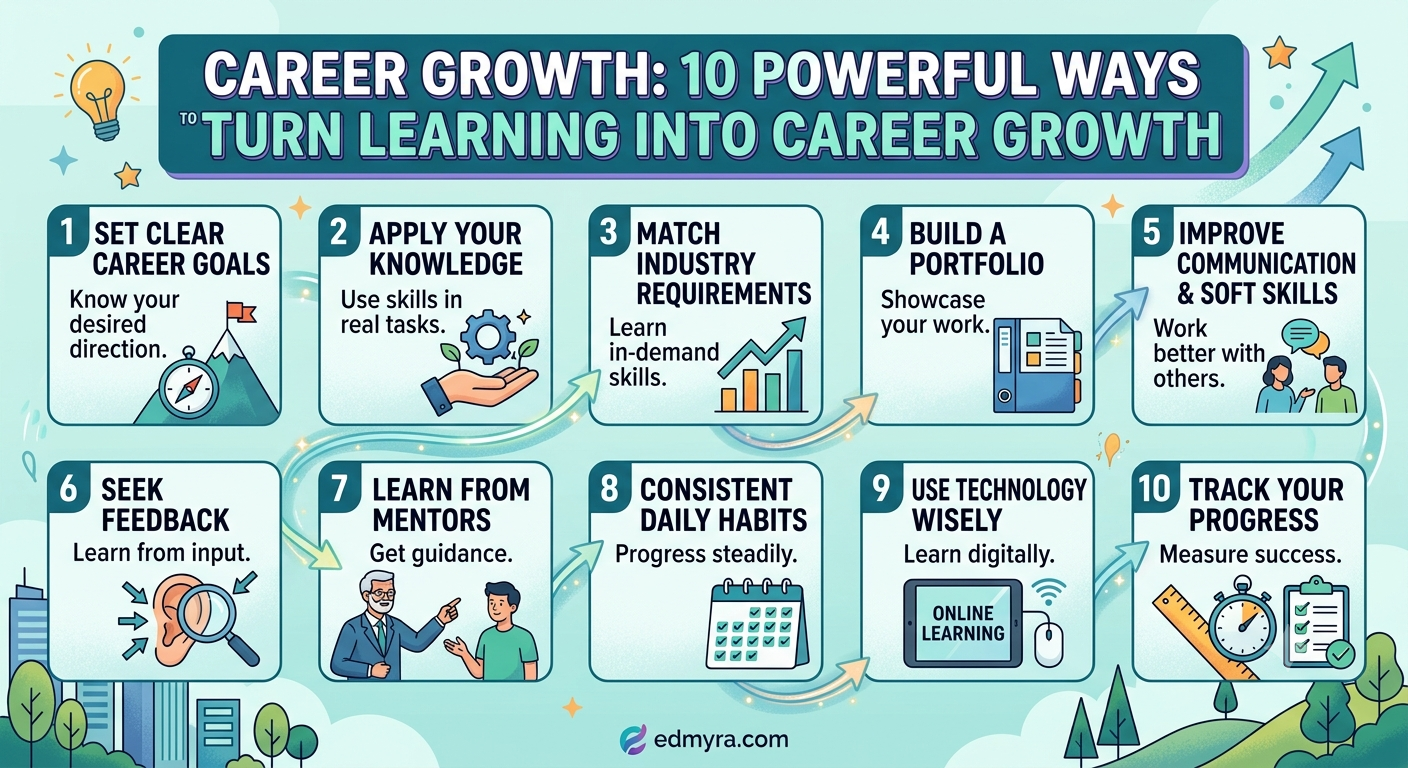
Career Growth: 10 Powerful Ways to Turn Learning into Career Growth
Introduction
To achieve career growth, gaining knowledge and developing new skills can help individuals discover better opportunities, improve their performance, and achieve their career growth. However, learning alone is not always enough. The real value of learning comes from applying new knowledge in practical situations and using it to solve problems. Learning into career growth means transforming the knowledge, skills, and experience gained through education, training, and daily activities into meaningful professional progress in career growth.
This process can help employees perform their jobs more effectively, prepare for new responsibilities, and become more confident in their abilities for career growth. For example, someone who learns technical writing can apply those skills to create user guides, product documentation, and troubleshooting articles. Similarly, a professional who learns communication skills can improve teamwork, participate more confidently in meetings, and explain ideas clearly.
Career growth does not always require changing jobs or earning another degree. Sometimes, small improvements in existing skills can make a significant difference. Learning how to use new software, improving time management, understanding industry trends, and developing problem-solving abilities can all contribute to professional skill development.
The key is to follow a clear plan, practise consistently, and measure progress over time.
Table of Contents
1. Set Clear Career Goals Before Learning

The first step toward career growth is understanding what you want to achieve. Without a clear goal, it can be difficult to decide which skills to learn or how to use your knowledge effectively.
Career goals provide direction and help you focus on learning activities that support your professional development for career growth.
For example, if you want to become a technical writer, your learning goals might include improving technical communication, understanding documentation tools, learning basic HTML, and practising the creation of user guides.
Instead of trying to learn everything at once, identify the skills that are most relevant to your desired position.
How to set effective career growth
- Identify your interests: Choose a career direction that matches your interests and abilities.
- Understand job requirements: Review job descriptions to identify the skills employers expect.
- Set short-term goals: Focus on achievable targets, such as completing a course or writing your first technical article.
- Create long-term goals: Decide where you want your career to be in the next two or three years.
- Review your progress: Evaluate your goals regularly and adjust them when necessary.
Setting clear goals makes learning more purposeful. It also helps you avoid spending time on skills that do not support your immediate career objectives. When your learning activities are connected to a specific professional goal, it becomes easier to recognise how each new skill contributes to your future for career growth.
2. Apply Your Knowledge Through Practical Experience
For example, learning about website hosting is useful, but creating a simple website helps you understand the process more clearly. Similarly, studying technical writing becomes more valuable when you create documentation that explains a technical process to beginners. Practical activities also help you identify areas where you need additional practice.
Ways to gain practical experience
- Work on personal projects related to your career.
- Complete exercises after watching educational tutorials.
- Practise using tools commonly mentioned in job descriptions.
- Volunteer for suitable assignments when opportunities are available.
- Create sample projects that demonstrate your skills.
- Review your work and improve it based on feedback.
You do not always need a paid position to gain practical experience. Personal projects and realistic practice exercises can help you develop useful skills. For instance, a beginner interested in technical writing could create an installation guide, a troubleshooting document, or a step-by-step tutorial for a software application. These projects can demonstrate your ability to organise information, explain procedures, and communicate clearly for career growth.
Remember: Learning gives you knowledge, but practice helps you turn that knowledge into a professional skill.
3. Develop Skills That Match Industry Requirements

Industries continue to change as technology, customer expectations, and business practices evolve. Professionals who regularly update their skills may be better prepared to respond to these changes. To support career growth, focus on skills that are relevant to your chosen industry and the roles you want to pursue for career growth. For example, a technical writer may benefit from learning documentation tools, basic markup languages, API documentation, and content management systems.
A marketing professional might focus on search engine optimisation, content strategy, analytics, and digital advertising. The goal is not to learn every available skill. It is to identify the most useful skills and develop them systematically.
How to identify valuable skills
Research job descriptions: Look for recurring technical and professional skills in vacancies related to your target role.
Explore industry developments: Read relevant articles, follow professional communities, and learn about new tools and working methods.
Ask experienced professionals: Mentors and colleagues can provide insights into the skills that matter in your field.
Evaluate your current abilities: Compare your existing skills with the requirements of your desired position.
Prioritise your learning: Start with skills that address the most important gaps.
Remember that technical knowledge is only one part of professional development. Communication, teamwork, adaptability, and problem-solving can also influence workplace performance. Combining relevant technical skills with strong professional abilities can help you become a more capable candidate for career growth.
4. Build a Professional Portfolio to Demonstrate Your Skills
A professional portfolio is a collection of work that demonstrates what you can do. It allows employers and clients to evaluate your abilities through examples rather than relying entirely on certificates or descriptions in your resume. A portfolio is particularly useful for careers involving writing, design, software development, marketing, and other project-based work.
For example, someone pursuing a technical-writing career could include user guides, troubleshooting articles, software documentation, and cloud computing tutorials.
A portfolio also creates a record of your progress. As your skills improve, you can replace older work with stronger examples for career growth. What should you include in your portfolio?
- Project title: Give each project a clear and informative name.
- Project objective: Explain the problem the document or project addresses.
- Tools used: Mention relevant software, platforms, or technologies.
- Process followed: Briefly describe how you completed the work.
- Final output: Include the finished document, screenshots, or other suitable examples.
- Skills demonstrated: Highlight the abilities that the project showcases.
You can create a simple portfolio using a website builder or an online publishing platform.
For each project, explain whether it was created as a personal learning exercise, an internship assignment, or professional work.
Be accurate about your contribution and avoid publishing confidential company information. A well-organised portfolio can help demonstrate initiative, practical experience, and a commitment to continuous learning. The important point is to show what you can do with your knowledge, not simply list what you have studied for career growth.
5. Improve Communication and Other Soft Skills
Technical knowledge can help you qualify for a position, but communication and interpersonal skills are often important for performing well at work. Professionals regularly need to explain ideas, ask questions, share updates, collaborate with colleagues, and respond to feedback.
Good communication helps reduce misunderstandings and makes it easier for others to understand your work.
For example, a technical writer must often convert complex technical information into simple instructions that users can follow. This requires not only technical knowledge but also an understanding of the audience, clear writing, and logical organisation.
Important soft skills to develop for career growth
Written communication: Practise writing clear emails, reports, instructions, and professional messages.
Verbal communication: Work on explaining your ideas clearly during conversations and meetings.
Teamwork: Learn to share responsibilities, listen to colleagues, and contribute to common goals.
Problem-solving: Practise identifying the cause of a problem and evaluating possible solutions.
Time management: Organise tasks, set priorities, and complete assignments within agreed deadlines.
Adaptability: Be willing to learn new processes, use unfamiliar tools, and respond constructively to change.
You can improve these skills through regular practice. For example, summarise what you learned each day, explain a technical topic to someone unfamiliar with it, or ask a colleague to review your communication. Small improvements can gradually increase your confidence and effectiveness for career growth.
6. Seek Feedback and Learn From Your Mistakes

Feedback is an important part of professional development because it helps you understand the difference between your current performance and the expected standard. When you work on a new task, you may not immediately recognise every mistake or area that needs improvement. Feedback from experienced colleagues, mentors, instructors, or reviewers can help you identify these gaps.
However, receiving feedback is only the beginning. You must also use it to improve your work. For example, a reviewer might explain that your article contains lengthy sentences, unclear headings, or instructions that are difficult to follow. You can use these observations to revise the article and improve your writing process.
How to use feedback effectively
- Listen carefully without interrupting.
- Ask questions if a suggestion is unclear.
- Identify the specific changes required.
- Revise your work using the feedback.
- Compare the revised version with the original.
- Apply the lesson to future assignments.
Mistakes can also reveal gaps in your knowledge. If you repeatedly struggle with a particular tool, review the relevant instructions and practise the process again. If your writing is difficult to understand, study examples of clear documentation and revise your sentences.
Instead of treating mistakes as proof that you cannot succeed, treat them as information about what you need to learn next. Being open to feedback demonstrates a willingness to improve, which is a valuable quality in almost any professional environment for career growth.
7. Learn From Experienced Professionals and Mentors
Learning does not have to happen only through formal education or online courses. Experienced professionals can provide practical knowledge that may be difficult to gain from books alone.
A mentor can help you understand workplace expectations, choose relevant learning goals, and identify opportunities for professional development.
For example, an experienced technical writer might explain how to organise documentation, work with subject-matter experts, manage revisions, or prepare content for publication. Learning from others can also help you understand common mistakes and discover more efficient ways to complete tasks for career growth.
How to learn from experienced professionals
- Ask specific questions about your work or career goals.
- Observe how experienced colleagues approach problems.
- Request constructive feedback when appropriate.
- Participate in professional communities and discussions.
- Attend relevant webinars, workshops, or industry events.
- Maintain professional relationships with people who share useful knowledge.
You do not necessarily need a formal mentoring programme. You can learn through conversations, professional networking, workplace collaboration, and discussions with people in your field. When asking for help, explain what you have already tried and identify the area where you need guidance. This makes it easier for others to provide useful advice. At the same time, respect their time and apply what you learn. Combining independent learning with guidance from experienced professionals can help you develop both technical competence and a better understanding of professional expectations for career growth.
8. Turn Learning Into Small, Consistent Daily Habits

Career development is a long-term process. Trying to learn many skills in a short period can become overwhelming, especially when you also have work, family, or other responsibilities.
A more practical approach is to build a consistent learning routine.
Even a short daily session can help you make progress when you use the time effectively and practise regularly. For example, you could spend 20 minutes studying a new concept, 20 minutes practising it, and 10 minutes reviewing what you learned. The exact schedule is less important than choosing a routine that fits your circumstances.
Simple habits that support career growth
Read regularly: Explore industry articles, professional blogs, documentation, and educational resources.
Practise one skill at a time: Focus on improving a specific ability instead of switching constantly between unrelated topics.
Keep learning notes: Record important concepts, examples, and questions that need further research.
Complete small projects: Turn what you learn into a practical output whenever possible.
Review your progress weekly: Identify what you completed and what you should improve next.
Reduce distractions: Choose a suitable time and environment for focused learning.
You can also maintain a learning journal that records your activities, challenges, and achievements.
For example, after learning how to create a technical document, you could write down the process, note any difficulties, and record how you resolved them. Over time, these notes can become a useful reference for future projects for career growth. Consistent learning habits make professional development more manageable and help you maintain momentum even when your schedule is busy.
9. Use Technology and Online Resources Wisely
Digital learning resources have made it easier to develop professional skills from almost anywhere. Online courses, video tutorials, documentation websites, webinars, and virtual communities provide opportunities to explore new subjects at your own pace. However, the large amount of available information can make it difficult to decide what to study. The solution is to choose resources based on your career goals and use them to support practical learning.
Useful ways to learn online for career growth
- Enrol in courses that teach skills relevant to your target role.
- Use official documentation to understand software and technical platforms.
- Follow educational channels that explain concepts clearly.
- Participate in relevant online professional communities.
- Use practice exercises to reinforce what you learn.
- Take assessments when available to check your understanding.
For example, someone interested in cloud computing could study introductory cloud concepts, practise creating basic resources in a cloud platform, and document the steps in a tutorial.
Similarly, someone learning search engine optimisation could study keyword research, practise improving a sample article, and evaluate the resulting content.
Certificates can help demonstrate that you completed a course, but they do not automatically prove practical competence. Whenever possible, combine online learning with projects that demonstrate your ability to apply the knowledge. Also, verify technical information using reliable sources, particularly when working with software, cloud services, or security-related topics. Using technology wisely means learning with a clear purpose rather than collecting courses without applying what they teach.
10. Track Your Progress and Look for New Opportunities

The final step is to measure your progress and use your developing skills to pursue suitable career opportunities. Without regular evaluation, it can be difficult to recognise how much you have improved or determine what you should learn next. Tracking progress also helps you identify strengths and gaps before applying for a new role or requesting additional responsibilities.
How to measure your professional growth
- Maintain a skills checklist: Record the skills you have learned and the ones you still need to develop.
- Review completed projects: Evaluate the quality of your work and note improvements over time.
- Update your résumé: Add relevant skills, projects, training, and achievements as you gain experience.
- Improve your portfolio: Include strong examples that demonstrate your current abilities.
- Review job requirements: Identify opportunities that match your experience and highlight any remaining skill gaps.
- Set new goals: Once you achieve one learning objective, decide what you want to accomplish next.
You can measure progress through practical results rather than relying only on the number of courses completed. For instance, creating a complete user guide, improving an existing article, explaining a technical concept clearly, or completing a cloud project can demonstrate the application of your knowledge.
As your abilities develop, look for appropriate opportunities to apply them through workplace assignments, internships, freelance projects, internal responsibilities, or job applications. Career growth does not always happen immediately. You may need time to practise, build experience, and improve your portfolio before reaching your next goal. Regular evaluation helps you stay focused and make informed decisions about your professional future.
Conclusion
Turning learning into career growth requires more than gaining knowledge. It involves applying new skills, developing professional habits, learning from feedback, and using your abilities to create meaningful results. The 10 strategies discussed in this article provide a practical starting point. Setting clear career goals helps you choose the right learning activities, while hands-on practice allows you to apply your knowledge. Building a portfolio demonstrates your abilities, and improving communication helps you work more effectively with others. Learning from mentors, maintaining consistent habits, using reliable online resources, and tracking your progress can further support your development.
You do not need to master every skill at once. Begin with one realistic goal, practise regularly, and gradually take on more challenging tasks. For example, if you want to become a technical writer, you could start by learning documentation principles, writing a step-by-step guide, reviewing it for clarity, and adding the finished project to your portfolio.
Each completed task can help you build experience and identify your next learning objective. The most important lesson is simple: knowledge becomes more valuable when you put it into action. By combining continuous learning with practical experience and consistent improvement, you can strengthen your professional abilities, prepare for new opportunities, and build a career that supports your long-term goals.
FAQs
1. What does turning learning into career growth mean?
It means applying the knowledge and skills you gain through education, training, and experience to improve your job performance, qualify for new responsibilities, and pursue better professional opportunities.
2. Why is continuous learning important for career development?
Continuous learning helps professionals update their knowledge, adapt to industry changes, develop new skills, and prepare for changing workplace expectations.
3. How can I apply what I learn to my career?
You can apply your learning by completing practical projects, improving your existing work, using new tools, solving workplace problems, and seeking opportunities to practise your skills.
4. Can online courses help improve career opportunities?
Yes. Online courses can help you develop relevant skills and understand new subjects. Their value increases when you apply what you learn through projects and practical exercises.
5. How can beginners gain practical experience without a job?
Beginners can create personal projects, complete practice assignments, contribute to suitable volunteer activities, participate in workshops, and develop a portfolio that demonstrates their skills.
6. What skills are important for career growth?
Important skills include communication, problem-solving, teamwork, time management, adaptability, technical knowledge, and the ability to learn independently.
7. How does a professional portfolio support career growth?
A portfolio provides examples of your work and demonstrates how you apply your knowledge. It can help employers understand your abilities, experience, and approach to solving problems.
8. How can feedback help with professional development?
Feedback helps identify mistakes, strengths, and areas for improvement. Applying feedback to future tasks can improve work quality and build professional confidence.
9. How much time should I spend learning new skills every day?
The ideal amount depends on your schedule and goals. Even 20–30 minutes of focused learning each day can be useful when you practise consistently and apply what you learn.
10. What is the best way to measure career growth?
You can measure career growth by tracking skill development, reviewing completed projects, collecting constructive feedback, updating your portfolio, and evaluating progress toward your professional goals.