

Currently Empty: ₹0.00



Uncategorized
Powerful Reasons the Perfect Balance of Textbook Knowledge and Real-World Experience Is Transforming Education in 2026
Education in 2026 is evolving as schools combine structured textbook knowledge with hands-on real-world experience. Discover how balancing fundamental book concepts with practical applications boosts retention, improves engagement, and equips students with crucial critical thinking skills for the modern world.
Table of Contents
Introduction
Education in 2026 is going through its biggest shift. The debate between textbook theoretical knowledge and real-world experiences has come to the conclusion that both are crucial for each other. Students are integrating textbook knowledge with the real world. The traditional system of textbook rote memorization is shifting towards modern real-world hands-on practice of textbook concepts that is making the future generation not a rote-learning generation but a smart problem-solving generation.
In 2026, where the textbook knowledge is fulfilling the present real-world experiences, students are becoming a lot more than rote learners. Educational thinkers and boards are promoting the integration of textbook and real-world learning as modernization is changing work needs. Here, employers are promoting skill sets, not degrees, so having hands-on experience has no longer remained an option; it has become a need that can affect your future career.
From the ages, Book remained a source of knowledge, and all success was based on that. When a student learned through textbook, it was considered that they would succeed, but that is now unreal, as the real-world needs communication, leadership, problem-solving, and analytical skills to face the modern world. Combining the theoretical knowledge of textbook with the practical world is becoming a standard for making students ready for the future.
Textbook Still Matters
Book is the most useful and convenient source of knowledge. This is not about eliminating textbook but about keeping a balance between both or integrating both. The theoretical knowledge of books, when combined with practical knowledge, creates real learning for students. Books are carefully designed by subject experts for imparting accurate, certified, structured, and age-appropriate knowledge to students. NCERT book that follows an accurate structure are the standard books across the country.
NCERT books are published by education boards through careful and accurate research, as they nationally act as proof for resolving any educational theory confusion. Boards have made NCERT book the standard for all educational institutions. Books provide a structured conceptual blueprint required to understand complex topics, but only rote memorization leads to passive learning. That’s why it should be collaborated with projects and practical experiments to understand it easily.
Book content can be understandable in abstract form. To make it concrete, it must be integrated with real-world learning. NEP 2020 has also suggested that the textbook theoretical content should be explained to students in concrete form through teaching aids. That makes it clear that textbook cannot be eliminated, as its importance can’t be ignored, but it is also important to provide hands-on real experiences, as it acts as a memory anchor, reinforcing theory learnt from physical books.
Why There Is a Need for Perfect Balance?
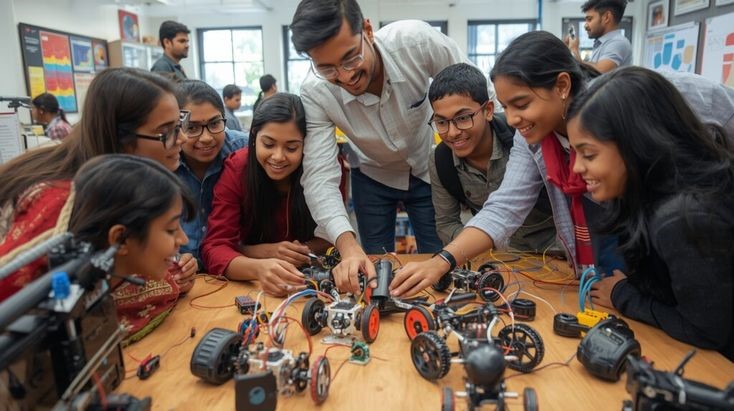
The importance of books cannot be ignored, and neither is it possible to eliminate them from the education sector. Whether there will be a need for hands-on experience, the textbook is also required for that. Textbook has rigid structured content that alone makes students rote learners if not combined with practical learning. So, integrating real-world practices through internships, experiments, practical work, workshops, industry visits, site visits, projects, debates, and laboratories gives students an opportunity to try their textbook content, which will help in deeper retention.
The workforce of 2026 and beyond is demanding skill, not merely degrees with high grades. Employers are looking for experience, problem-solving, and analytical thinking in employees, not just degrees. The New Education Policy is also focusing on providing skill knowledge from Class 6 to make students ready for future careers. The integration of skill into the main curriculum of classes has altered the entire dynamic of the classroom.
Educational institutes, by combining the theoretical knowledge of textbook with practical hands-on experience and skills, are helping students to be ready for the future modern world so that they become ready enough to solve the problems of work with their skill.
The Government of India is alongside channelising projects like Skill India to give students a chance to earn skills for the future. Many scholars have passed college, and many are studying in it, so to help them get jobs, the Government of India is channelising the project named Skill India to impart skills to them. Skill India is a step to help students take a step towards the corporate world and make them realize that degrees are not enough.
Students are able to convert their passive knowledge into active knowledge through practice in the real world that will help them in deeper memorization. The theoretical formulas are only for rote learning, but the real learning is applying them in real life effectively. Education is beneficial only when people are able to use it in the practical world, as mere rote learning is a boring task with very less efficiency. Real-world variables help in troubleshooting unexpected obstacles.
Students become able to adapt to any real-world unexpected conditions if they have learned to apply the theoretical knowledge in real scenarios. That’s why now the education sector is about encouraging students to try on their own and teachers as helpers only. The role of teachers is also changed to helpers in experiments and group discussions, as the New Education Policy suggests that students should be given enough time to actively learn concepts through their understanding rather than just reading from textbook and following teacher concepts.
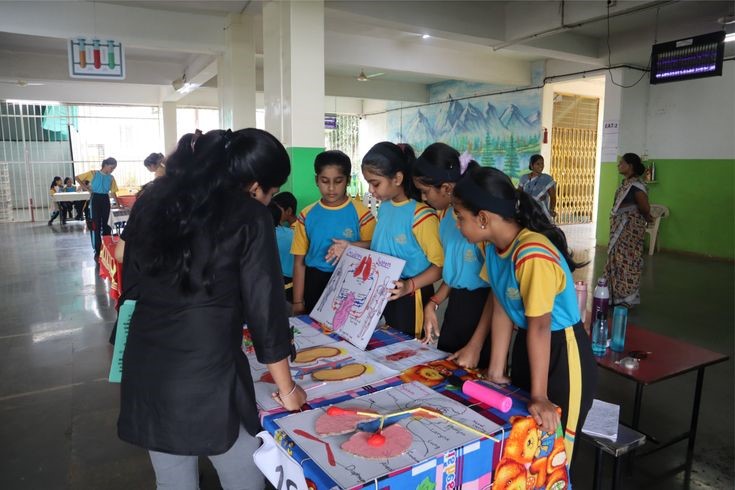
Students who repeatedly execute their theoretical learning in practical scenarios gain the confidence to tackle problems on their own in the future. The students who actively take part in school activities become the best in communication, leadership, decision-making, creativity, and other skill that are going to help them in the future.
Textbook helps the students to get practical knowledge. New NCERT books are designed in that format where they include practical learning experiments with theory so that experiments should be conducted in classes by the teacher. This makes it clear that textbook like NCERT book itself promotes the integration of it with real-life hands-on experience, where a student will learn through observation and experience.
Today’s generation is smart and intellectual. They are more dedicated to skill learning. They are learning handicraft skills, coding skills, as technology has made it easier to get skill training at their own convenience and schedule rather than rigid schedules of classes. Digitalisation is helping students to get skill learning at minimal costs or free through YouTube channels. More and more students are getting themselves enrolled in that type of skill learning.
Universities have made it compulsory to get internships in their curriculum period. That also makes it clear that even the educational sector wants students to integrate both, as skill is no more an option; it has become a necessity to get the perfect career in the future. Skill builds confidence in people to adapt to future dynamics.
Universal Digital Access and Portal Logins
Some people have the view that textbook are not that much convenient to carry everywhere, but now a person can do textbook login on their digital device anywhere, as the internet is filled with millions of textbook PDFs. If a person wants to see any information from around the world, it can be seen from anywhere with just one textbook login. At one login, someone can get an entire textbook PDF that removes the boundaries of carrying textbook with them.
As it is not even possible to buy so many books, in that situation also, textbook PDF can be a game changer. Old and new types of NCERT book can be read through textbook login on that page and then downloaded. Even by scanning that content, teachers can then export it in AI apps, saying to provide the practical activity on that, which will give them ideas on how a practical experiment can be conducted over this.
Conclusion
Education is having its biggest revolution where the debate is about textbook and real-life experiments. The importance of textbook cannot be evitable, but imparting only theoretical concepts to students also makes them rote learners. So, to eliminate such a situation, there is a need for integrating real-life scenarios with theoretical knowledge, as the new modernization is also supporting skills rather than degrees. The government is also channelising projects like Skill India to support skills.
Importance of NCERT book and other book cannot be reduced, as they are accurate and certified material. But applying them in current scenarios is important to help in deeper retention. It is easy to do textbook login anywhere and get the required textbook PDF in this digitally advanced India that will help you get knowledge anywhere in the world.
As the education sector is changing with time, a perfect balance of textbook with real-life hands-on experience creates results that are a real game changer. It will not only help in getting good grades but also make students ready to face future struggles with confidence. The aim is not only to succeed in examinations but also to succeed in life and contribute something meaningful to society.
FAQs
Why integrating book and real-life scenarios is important?
Textbook has rigid structured content that alone makes students rote learners if not combined with practical learning. So, integrating real-world practices through internships, experiments, practical work, workshops, industry visits, site visits, projects, debates, and laboratories gives students an opportunity to try their textbook content, which will help in deeper retention.
What is the importance of books?
Books are carefully designed by subject experts for imparting accurate, certified, structured, and age-appropriate knowledge to students. NCERT book that follows an accurate structure are the standard books across the country.
What is the new workforce?
The workforce of 2026 and beyond is demanding skill, not merely degrees with high grades. Employers are looking for experience, problem-solving, and analytical thinking in employees, not just degrees.
What are the benefits of getting skill knowledge?
Students are able to convert their passive knowledge into active knowledge through practice in the real world that will help them in deeper memorization. The theoretical formulas are only for rote learning, but the real learning is applying them in real life effectively. Education is beneficial only when people are able to use it in the practical world, as mere rote learning is a boring task with very less efficiency. Real-world variables help in troubleshooting unexpected obstacles.
How will skill knowledge help in facing future changing dynamics?
The real-world needs communication, leadership, problem-solving, and analytical skills to face the modern world. Combining the theoretical knowledge of textbook with the practical world is becoming a standard for making students ready for the future changing dynamics.