

Currently Empty: ₹0.00



Uncategorized
10 ways why learning AI today can give you an edge in tomorrow’s tech industry
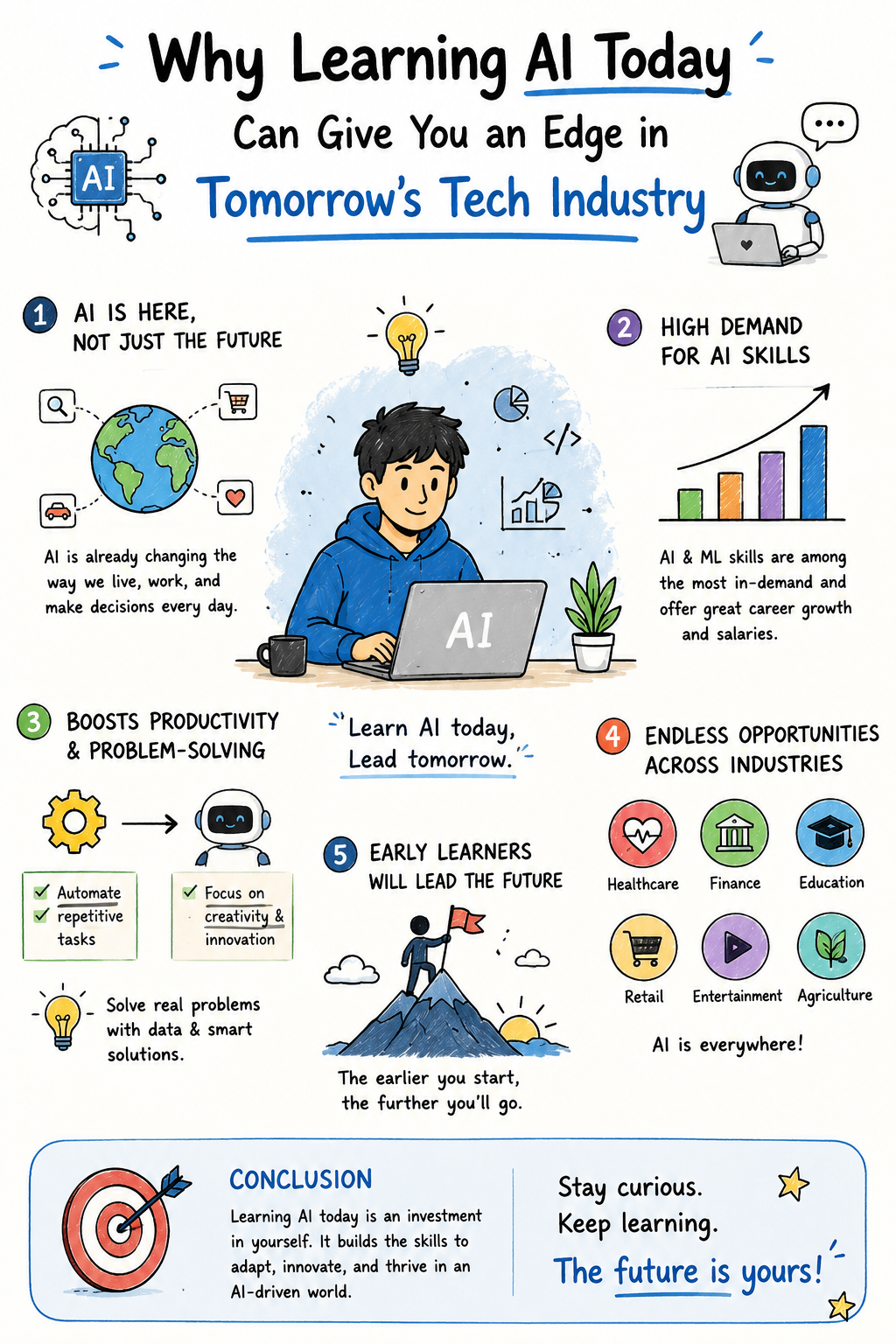
Artificial intelligence is coming for us all
From AI chatbots to code completion, recommendation systems, and AI business applications, learning AI has become extremely important as AI takes over the technology space and the competencies needed to work with it.
Why is this important to you?
Well, to reiterate, you don’t have to dive right into a career as an AI researcher to realize the importance of understanding artificial intelligence better than your peers
Whether you are a student, a developer, a writer, an engineer, an analyst, or a different type of tech professional, I think it is fair to say that learning AI can become an invaluable skill for you in the future
Here are reasons why:
Learning AI Will Make You More Marketable
AI is no longer a niche field dominated only by machine learning engineers and data scientists.
Many areas are beginning to adopt and use AI to their advantage
Therefore, you must understand learning AI because it will benefit you and your future job
If you are a software developer, you can begin to use AI to help you code and better understand, debug, and analyze other people’s code, or create applications with the use of AI.
If you are a cybersecurity expert, you can use machine learning algorithms to help detect certain network anomalies.
If you are a business owner, you can begin to use recommendation systems to better understand your customers and automate many tasks.
Therefore, you see that with AI you can complement your skills with it and supercharge them.
You don’t need to be a machine learning expert to begin learning AI, if you already know how to code you can begin to use your coding skills to build machine learning applications, if you have an expertise in cyber security you can begin using AI to help you in your field, if you’re a technical writer, you can begin learning about large language models to improve your writing and documentation skill.s
Therefore, it is not too late for you to begin learning AI to make yourself more marketable in the future tech job market
Learning AI Will Make You More Adaptable
As mentioned in the previous section
learning AI is becoming ubiquitous, and many areas are adapting their approaches to include AI methods and models.
But how are you supposed to be “adaptable” to the future tech job market if you do not understand how to use these innovations?
I think that one of the most important skills that you can obtain from learning AI is adaptability.
Adaptability, it seems, is one of the most sought-after skills by almost any tech-related job.
This is because the tech space is super fast-paced, and you must always be willing to learn and adopt new tools, languages, and methods before it is too late.
If you are not willing to learn new programming languages and new tools your company is using, you will not be able to keep up with the rest of your peers who are
Therefore, I think that learning AI can help you be more adaptable
It helps you get a grasp on the modern approaches being made in technology, and it will give you a better understanding of tech at large.
Of course, you will not know all of the latest approaches being made in AI, but you will have an understanding of their principles.
You will be able to understand why neural networks are so useful in detecting patterns; you will know how machine learning differs from traditional programming; you will know why generative AI is such a big deal, etc.
Yes, while you might not know all of the latest advances being made in AI, I think it is much more important to know the fundamentals if you want to be more adaptable in the tech industry.
You do not need to memorize every single advance being made in AI to be successful in your career.
You simply need a fundamental grasp of what is happening to be able to adapt to the future.
Learning AI Will Help You Be More Productive
Another important reason for learning AI is that it will help you be more productive.
Many tech workers have to do repetitive tasks throughout their workday
Whether it is coding, organizing, documenting, or researching, there is an AI tool for all of these tasks.
While AI tools can help you speed up and automate these tasks, it is important to know how to make the most of them.
Therefore, I think that learning the fundamentals of AI can be helpful to you, no matter what tech specialty you choose to pursue in the future.
You must know how to get the most out of it if you want to maximize your own productivity.
However, you must also understand that while these AI tools can be extremely helpful, it is not as simple as asking questions and getting answers.
You must know how to ask questions in a way that the AI will give you the correct answers if you want to use these tools wisely.
This is why I think it is important to understand the basics of AI literacy.
If you know what AI can and cannot do, you will know how to use it to your advantage and maximize your own productivity.
Sure, you might not be able to fully automate the task at hand
But at least you will be able to get better results than someone who does not know much about AI.
For example, you can use specific instructions and prompts to get better results instead of generic ones; you can fact-check the information that the AI gives you, etc.
In short, by being literate in AI, you will become more productive.
Learning AI Fundamentals Does Not Require Advanced Math Knowledge
While many people who are not very math-oriented might be turned off from learning AI, since they think that math and programming are some of the hardest things in the world
Learning the fundamentals of AI does not involve as much math as one might think.
You can begin coding in Python with minimal math knowledge, and progressively add to your math skills as you advance in your learning.
You can begin to learn the fundamentals of programming before diving into data science, machine learning, and eventually deep learning.
You can learn Python programming, then data science, then machine learning, and eventually deep learning.
Once you have fundamental knowledge in Python, data science, and machine learning, you can venture into the world of deep learning, and eventually large language models and generative AI.
You see, learning AI is a process that takes time and patience, but it is not as hard as many people are beginning to think.k
Exploring Generative AI Can Help You Learn AI Faster
Now that we have gone over the general way of learning AI, let’s talk about generative AI
With the rise of large language models came a revolution in the way that people can interact with AI.
Due to how intuitive and user-friendly these models are, many non-technical people are beginning to explore the world of A, without prior coding experience.
Therefore, I think that this is the perfect time to begin exploring and learning AI, since you will not need any coding experience to do so.
These large language models can act as coding assistants, documentation tools, and much more.e
They can enable anyone to begin using AI, even if you have no experience coding.
Generative AI has even led to the creation of a new branch of study, known as prompt engineering.
Now, while learning prompt engineering can be helpful, I think it is even more important to understand what goes on “under the hood”
You should allocate time and effort to understanding how large language models work.
By learning the fundamentals of tokenization, training data, machine learning, embeddings, context windows, hallucination, model evaluation, and retrieval-augmented generation, you will be much better prepared to use, work with, and eventually build AI applications.
Generative AI Is a Great Way to Get Started With AI
One of the main reasons why people are afraid to get into AI is because of how much they have to learn before doing anything meaningful.
They have to learn Python, then machine learning, then deep learning, then computer vision or natural language processing (depending on their interests), etc.
While this can be daunting for someone who just wants to build something with AI
I think that you will find generative AI to be an interesting place to start.t
Since it is much easier to use and understand than traditional machine learning and deep learning, it allows you to experiment and play around without much experience.
You can start using it right away and see what you can do
You can use it to write articles and build applications, and eventually build a strong foundation for further studies in AI.
Getting Started With AI Gives You More Opportunities
Another reason why you should consider learning AI is because of the sheer amount of opportunities it offers.
AI can be implemented in almost any tech-related field.
Therefore, it is definitely worth considering adding AI literacy to your skill set, since it can greatly benefit you in terms of employability.
For example, apart from traditional jobs in AI, such as machine learning engineer and data scientist, there are many opportunities for software developers, such as building applications with AI or developing AI tools for other companies.
There are also opportunities for technical writers, such as writing documentation for AI products, and many more.
Additionally, because prompt engineering is a fairly new branch of study, there are many opportunities for people with little to no coding experience, such as becoming a prompt engineer.
You see, the thing about jobs in AI is that they are constantly evolving
The opportunities that arise for you in the next year are impossible to predict
Therefore, instead of trying to chase after every single opportunity in your field, it would be much more beneficial to acquire skills that have wide applications and will always be useful, no matter what happens.
The ability to code, and subsequently, the ability to do machine learning and deep learning, is valuable.
However, so are the ability to learn, understand, evaluate, and work with existing AI systems
These abilities can be applied to many different fields and therefore are much more valuable.
Alternatively, you could build a language model that can answer questions, using a set of data that you specify.
The point is, you want to showcase your knowledge and skill through projects to prove to employers that you understand what you are doing.
The projects themselves do not need to be that complex; a simple showcase of your skills in a certain area will suffice, as opposed to a project you barely understand.
By building applications with AI, you can further hone your skills, prove your knowledge, and eventually get hired.
Learning AI Is an Investment in Yourself
However, in my personal opinion, the most important thing you can do to invest in yourself is to adopt the mindset of continuous learning.
AI literacy should not be static; it should be constantly updated
You always want to learn more about what is happening in this space and subsequently apply that knowledge to your practice to get better
By learning generative AI and other areas of AI, you are constantly investing in your own future and, subsequently, making yourself more desirable to employers.
How to Learn AI: A Roadmap for Beginners
Now that we have gone over some reasons why you should learn AI, let’s discuss how you can go about doing that
As mentioned above, the best way to invest in your future is to start learning AI today
Here is a general guide of things you can do if you are completely new to the space, but want to get started:
- 1. Learn to code
Beginners should start with the fundamentals of Python, and then progress to data science, machine learning, and deep learning. You can also take courses on Coursera and edX that are specifically designed for learning AI.
- 2. Learn data
Take an introductory course on statistics, and learn how data sets are processed in data science with Python libraries, such as pandas and numpy
- 3. Learn machine learning
Study the fundamentals of machine learning, and begin exploring the different algorithms in Python.
- 4. Learn deep learning
Learn the fundamentals of neural networks and explore deep learning with PyTorch or TensorFlow.
- 5. Get to know generative AI
Get to know the fundamentals of language models and experiment with generative AI
- 6. Get hands-on experience
Apply your knowledge of machine learning, deep learning, and generative AI to build applications. Showcase your skills by building a portfolio
- 7. Continue learning
Follow news in the space of AI and machine learning, and continue challenging yourself to learn new concepts and update your skills
These are only general guidelines of things you can do if you are a complete beginner and want to get into AI.
Of course, your personal roadmap will look much different, since everyone learns at different paces.
However, I hope that I have convinced you that it is extremely important to invest time and effort into learning the fundamentals of AI if you want to become more desirable and valuable in the future job market.
AI Is Coming for the Tech World
Apart from studying AI fundamentals, however, I think it is also important to apply that knowledge to build better applications and improve existing ones.s
The best way to do that is to experiment with generative AI and use it to make things.
By doing this, you can gain valuable experience and better understand what AI can and cannot do.
This, in turn, will give you the confidence and knowledge you need to think critically about how to approach AI, what changes you should suggest, and how to build better products than your competitors.
You see, I think that the most important thing for you to learn, right now, is how to think alongside AI, and how to use it to get things done.
Final Thoughts
Artificial intelligence is coming, and it is coming for the tech world. However, it should not scare you!
You do not need to become an expert-level AI researcher to benefit from understanding this field better than most of your peers.s
Therefore, all you need to do is begin learning artificial intelligence, and never stop!
Once you have grasped the fundamentals of this space, you can begin experimenting with generative AI and see what you can build with it.
And, when you have gained enough experience, you can put your skills to the test and build a project that will serve as proof of your knowledge.
This way, you will be able to showcase your skills to potential employers, since you will have proven to yourself that you actually understand what you are doing.g
The future will no doubt bring exciting discoveries and breakthroughs in the field of artificial intelligence, but there is nothing stopping you from contributing to that future right now.
Learn Online Skills in 2026 for a Brighter Tomorrow
[…] 2026, many people are using AI tools to write drafts, brainstorm ideas, summarize information, learn new subjects, organize tasks, […]