

Currently Empty: ₹0.00



Uncategorized
Degree vs Skills: What Matters More for Career Success in 2026?
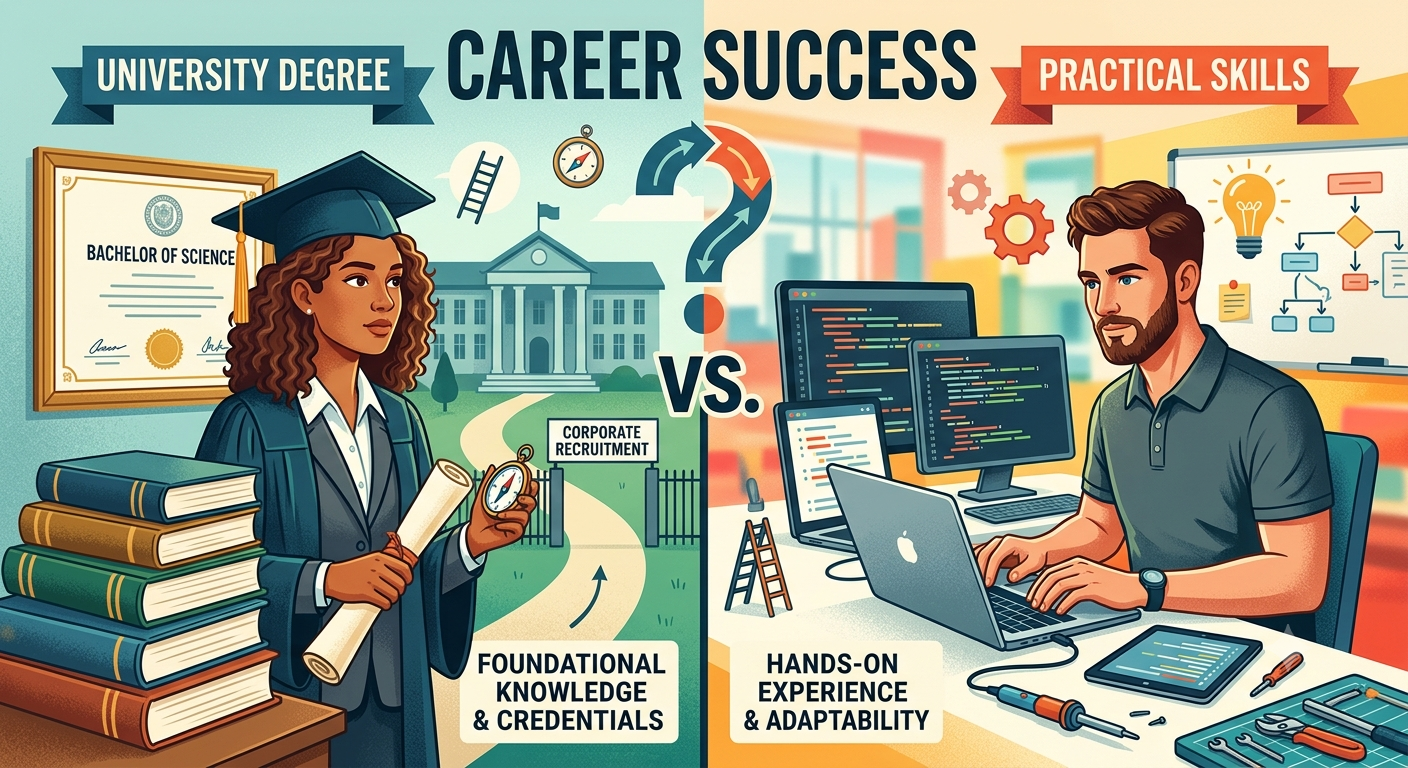
There was a time when getting a degree seemed like the obvious path to a successful career.
You finished school, went to college, earned a degree, found a job, and slowly worked your way up the career ladder.
But the world of work has changed.
Today, you’ll find people with impressive degrees struggling to find the right job, while others without traditional degrees are building successful careers through practical skills, experience, freelancing, entrepreneurship, or online learning.
This raises an important question:
When it comes to career success, what matters more — a degree or skills?
The honest answer is: it depends.
A degree can open certain doors. Skills can help you prove that you deserve to walk through them. And experience can show employers that you know how to use those skills in the real world.
So, instead of treating a degree and skills as two competing choices, it makes more sense to understand how they work together.
Table of Contents
What Does a Degree Actually Give You?
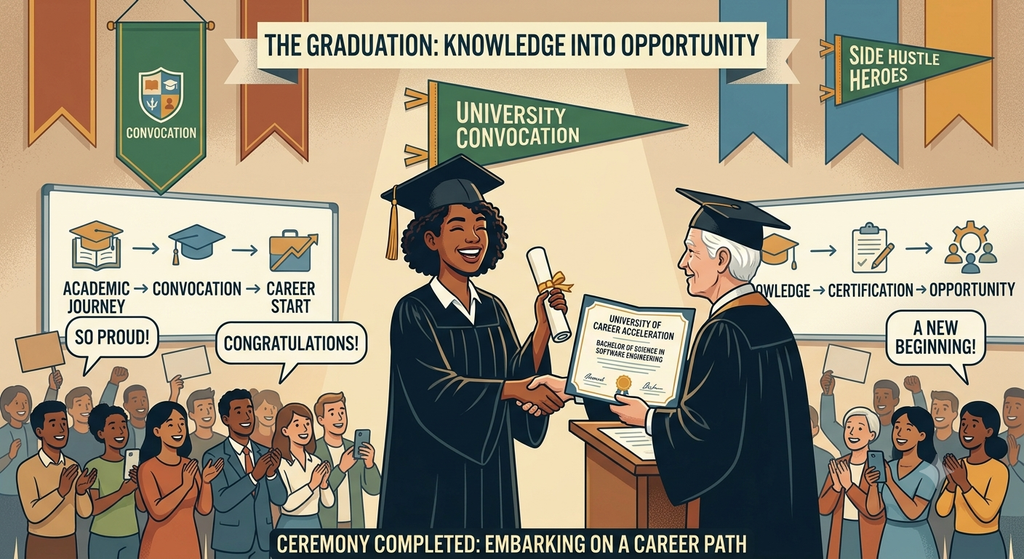
A degree gives you more than a certificate to put on your résumé.
For many students, college is where they develop a basic understanding of their chosen field. They learn theories, concepts, research methods, and professional fundamentals.
For example, a computer science student may study programming, databases, algorithms, and software development. A business student might learn about finance, marketing, management, and economics.
This knowledge can be extremely useful.
A degree can also be essential for certain professions. If you want to become a doctor, lawyer, teacher, engineer, or enter another regulated profession, formal education and qualifications may be required.
There is also another advantage that people sometimes overlook: access.
College can introduce students to professors, classmates, internships, career fairs, alumni, recruiters, and professional networks. These connections can sometimes become valuable opportunities later.
But there is one important limitation.
A degree doesn’t automatically mean you know how to do a job.
You may understand marketing theory but have never run a real campaign. You may have studied programming but never built an application for an actual user. You may understand business concepts but have never worked with a demanding client.
That’s where skills come in.
Why Skills Matter So Much
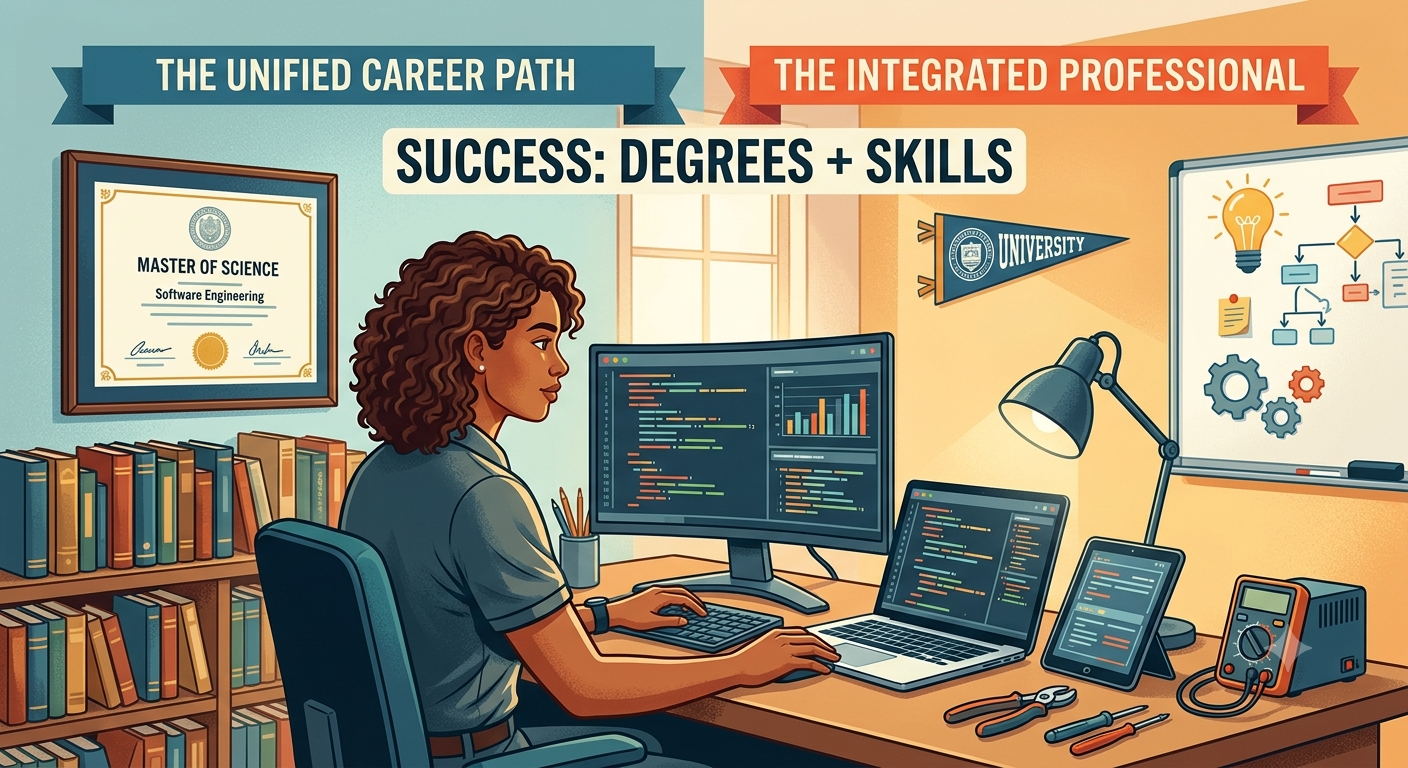
Think about the difference between knowing how something works and actually being able to do it.
Someone can watch dozens of videos about photography and understand lighting, composition, and camera settings. But that doesn’t necessarily make them a great photographer.
The same is true in the workplace.
Skills are what allow you to take what you’ve learned and actually get something done.
These skills can be technical, such as:
- Programming
- Data analysis
- Graphic design
- Video editing
- Digital marketing
- SEO
- Financial analysis
- Project management
- Cybersecurity
- Cloud computing
Then there are soft skills, which are useful in almost every career:
- Communication
- Teamwork
- Problem-solving
- Time management
- Leadership
- Creativity
- Adaptability
- Critical thinking
Imagine two employees who have similar qualifications.
One struggles to explain ideas, misses deadlines, and finds it difficult to work with others.
The other communicates clearly, solves problems independently, learns quickly, and works well with the team.
Even though their educational qualifications might look similar on paper, their day-to-day performance could be very different.
That’s why skills matter.
Degree vs Skills: Is It Really an Either-Or Choice?
Not necessarily.
In fact, for many people, the real advantage comes from having both.
Here’s a simple way to look at it:
| Degree | Skills |
|---|---|
| Provides structured education | Provide practical ability |
| Builds theoretical knowledge | Help you apply knowledge |
| May be required for certain careers | Can be useful across many careers |
| Can help meet job requirements | Can demonstrate what you can actually do |
| May help with initial screening | Can strengthen your portfolio and résumé |
A degree may help you get considered for a position.
Your skills may help you get selected.
Your experience may help you succeed after you’re hired.
Of course, hiring doesn’t work this neatly every time. Every company and industry has its own expectations.
But it highlights why focusing on only one side can be limiting.
When a Degree Matters More
There are some careers where a degree isn’t simply a nice addition — it’s part of the professional pathway.
Think about careers such as medicine, law, teaching, and several engineering or regulated professions. You generally can’t replace the required education simply by watching online tutorials or completing a few short courses.
In these situations, formal education matters.
A degree can also be useful if you’re aiming for graduate-level roles where employers specifically ask for a particular educational background.
For students who aren’t sure what they want to do yet, university can also provide time to explore different subjects and develop a broader foundation.
But there’s a catch.
Getting a degree just for the sake of having a degree isn’t necessarily a career strategy.
Before choosing a course, think about where you want that qualification to take you.
What jobs does it prepare you for?
What skills will you gain?
Will you get opportunities for internships or practical projects?
Those questions can be just as important as the name of the qualification.
When Skills Can Make a Bigger Difference
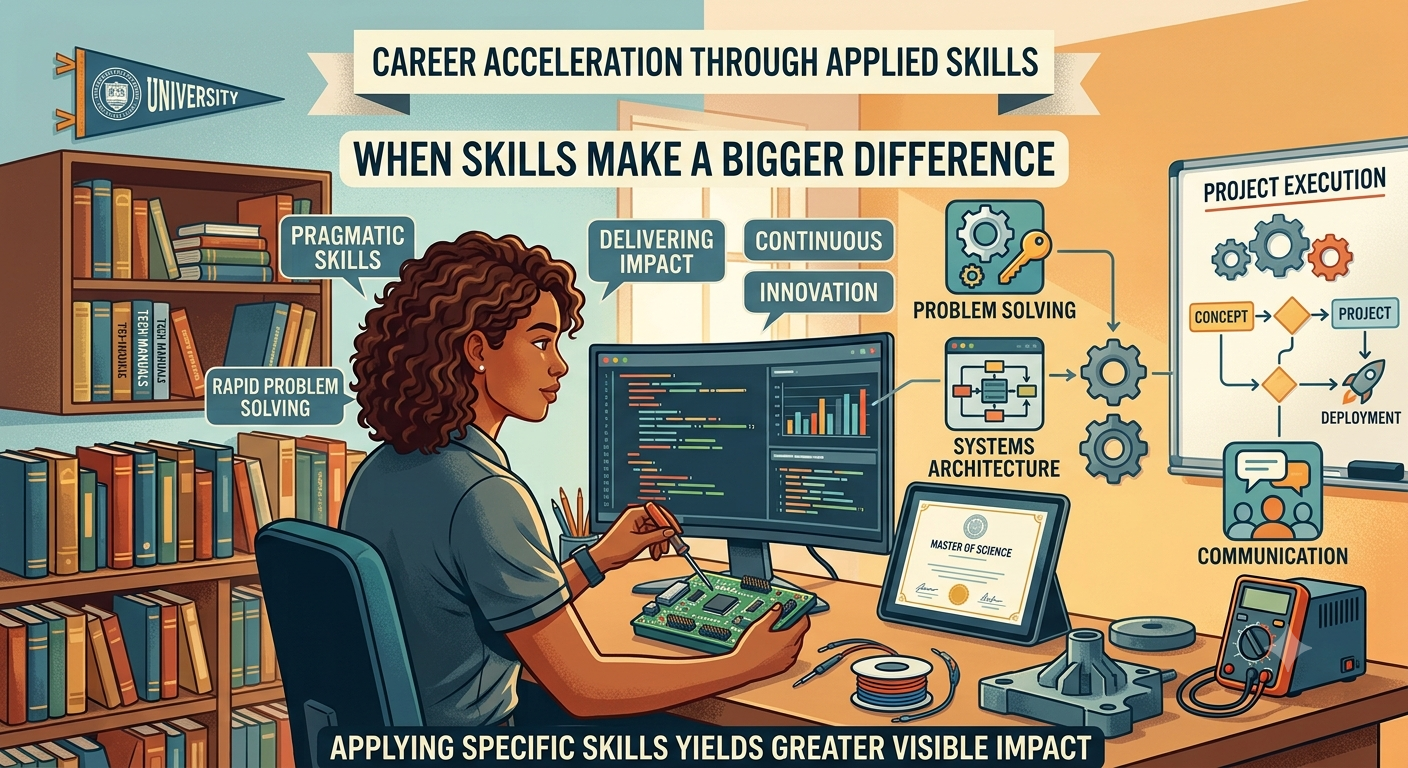
Now consider industries where employers can easily see what you can actually produce.
Design is a good example.
If you’re applying for a graphic design job, an employer may want to see your portfolio. They can look at your logos, advertisements, illustrations, websites, or other projects and get a sense of your abilities.
The same idea applies to programming.
A developer who can show useful applications, websites, open-source contributions, or personal projects has something tangible to discuss during an interview.
Digital marketing is another example.
Instead of simply saying, “I understand social media marketing,” you can demonstrate campaigns you’ve worked on, content you’ve created, or results you’ve achieved.
This is one of the biggest advantages of practical skills:
They can often be demonstrated.
You don’t just tell someone what you know. You show them.
Experience Is the Missing Piece
There’s another factor that often gets left out of the degree-versus-skills debate: experience.
Imagine a company is hiring for an entry-level marketing position.
Candidate A has a relevant degree but hasn’t worked on anything outside the classroom.
Candidate B has the same degree but has also completed an internship, managed a small social media account, created a few campaigns, and built a portfolio.
Both candidates have the qualification.
But Candidate B has more evidence of applying what they learned.
That’s why internships, freelance projects, volunteering, part-time jobs, and personal projects can be so valuable.
You don’t always have to wait for your first full-time job to gain experience.
Why Continuous Learning Matters
Getting a degree isn’t the end of learning.
In fact, for many professionals, it’s just the beginning.
Technology changes. Industries change. Customer expectations change. New tools appear. Some jobs evolve significantly within just a few years.
This means that professionals need to keep learning.
Fortunately, learning today doesn’t always require going back to university.
You can develop new skills through:
- Online courses
- Professional certifications
- Workshops
- Books
- Podcasts
- Industry events
- Mentorship
- Personal projects
- Workplace training
- Freelance work
For example, someone who studied marketing several years ago may now need to understand analytics, social media platforms, content strategy, automation, and new digital tools.
The degree provides the foundation.
Continuous learning keeps that foundation relevant.
How Students Can Build Skills While Studying
If you’re currently in college, you don’t have to wait until graduation to become job-ready.
Start small.
Build Personal Projects
Create something related to your field.
A computer science student could build an app.
A marketing student could create a small digital campaign.
A design student could create branding concepts.
A finance student could build a financial analysis project.
The goal isn’t necessarily to create something perfect. The goal is to practice.
Look for Internships
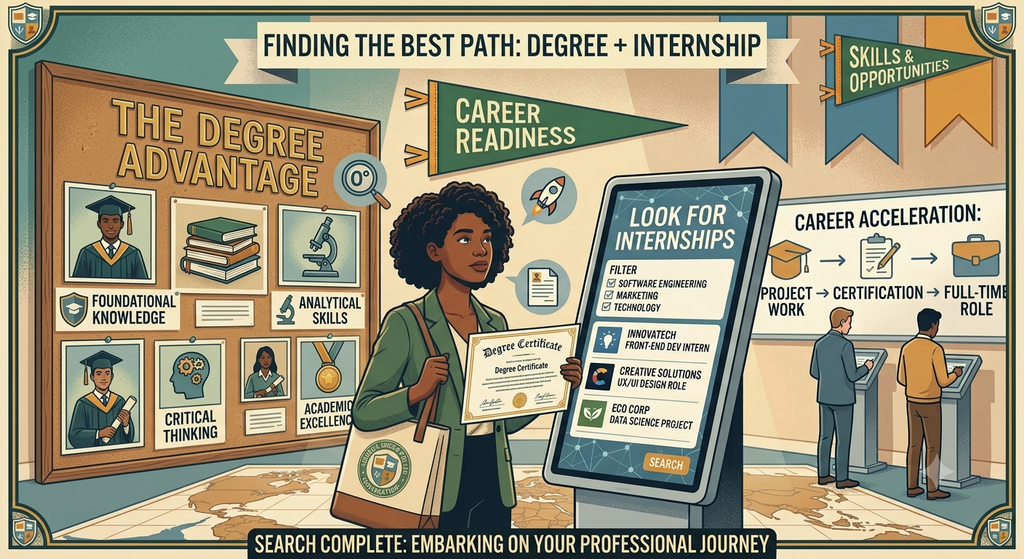
An internship can give you a glimpse of what working in your chosen industry is actually like.
You’ll learn things that aren’t always taught in classrooms — how meetings work, how deadlines are handled, how teams communicate, and how problems are solved.
Create a Portfolio
Don’t simply tell employers that you’re good at something.
Show them.
Depending on your career, your portfolio might include:
- Writing samples
- Design work
- Apps or websites
- Marketing campaigns
- Data projects
- Research
- Videos
- Presentations
A portfolio can turn an abstract claim about your skills into something concrete.
Improve Your Communication
You can be excellent at your technical work and still struggle professionally if you can’t communicate your ideas.
Learn to write clearly. Practice presentations. Ask questions. Listen carefully. Learn how to explain complicated ideas in simple language.
These skills can make a difference in almost any workplace.
So, What Do Employers Actually Look For?
There’s no single answer because every employer is different.
Some companies may place strong emphasis on educational qualifications. Others may care more about portfolios, certifications, technical ability, or previous experience.
In many cases, employers are trying to answer several questions:
Does this person have the necessary knowledge?
A degree or relevant education may help answer that.
Can this person actually do the work?
Skills, projects, and assessments can help demonstrate that.
Have they applied these abilities before?
Experience can provide evidence.
Can they work effectively with other people?
Communication, teamwork, and adaptability become important here.
This is why a strong candidate often brings several pieces together rather than relying on one credential.
Should You Choose a Degree or Skills?
If you’re trying to decide what to focus on, start with your career goal.
Ask yourself:
- Does my chosen career require a formal degree?
- What qualifications do employers usually ask for?
- Which technical skills are important in this field?
- Can I gain practical experience while studying?
- What kind of portfolio could I build?
- Would a certification add value?
- What opportunities will help me learn by doing?
The answers will be different for everyone.
If you want to become a doctor, formal education is obviously central to the journey.
If you want to become a freelance designer, your portfolio and practical skills may receive much more attention.
If you want to work in technology, you may benefit from combining formal education with programming skills, projects, certifications, and experience.
The key is to understand what your specific career path demands.
Degree vs Skills: The Bottom Line
So, what matters more for career success — a degree or skills?
There isn’t one answer that applies to everyone.
A degree can give you a strong academic foundation, open doors to certain professions, and provide valuable opportunities and networks.
Skills help you turn knowledge into action.
Experience helps you prove that you can apply those skills in real situations.
And continuous learning helps you stay relevant as your career develops.
Instead of thinking of the choice as “degree vs skills,” think of it as:
Degree + Skills + Experience + Continuous Learning.
You may not need all four in equal amounts, and the right combination will depend on your career.
But one thing is clear: your career is unlikely to be defined by a single line on your résumé.
What you know matters.
What you can do matters.
And what you can learn next matters too.
FAQs
Q. Is a degree more important than skills?
A. It depends on the career and employer. Some professions require formal qualifications, while others place greater emphasis on practical skills, portfolios, and experience. In many careers, a combination of education and practical ability is valuable.
Q. Can skills replace a degree?
A. In some industries and roles, strong practical skills and experience can reduce the importance of a traditional degree. However, they cannot replace formal qualifications where professional or legal requirements make a degree necessary.
Q. What skills are most important for career success?
A. It depends on your profession. Technical skills are important for performing specific tasks, while communication, problem-solving, teamwork, adaptability, and time management are useful across many different careers.
Q. Do employers still care about degrees?
A. Yes. Degrees remain relevant for many employers and are essential for some professions. However, the importance placed on degrees varies by industry, company, role, and hiring requirements.
Q. Should I develop skills while pursuing a degree?
A. Definitely, internships, personal projects, freelance work, volunteering, certifications, and other practical experiences can help you turn classroom knowledge into useful workplace skills.
Q. Is experience more valuable than education?
A. Education and experience serve different purposes. Education can provide theoretical knowledge and formal qualifications, while experience shows how effectively someone can apply knowledge in real situations. Their relative importance depends on the role.
Q. How can I become job-ready without work experience?
A. Start with personal projects, internships, volunteering, freelance assignments, competitions, or practical coursework. Build a portfolio that demonstrates what you can actually do.
Q. Can a degree guarantee a successful career?
A. No. A degree can provide knowledge and opportunities, but career development also depends on skills, experience, professional performance, adaptability, networking, and continued learning.
Q. What is the best approach to long-term career growth?
A. Focus on building a combination of relevant education, practical skills, experience, communication abilities, and a willingness to keep learning. The right balance will depend on your career goals.